Dr. Ko-Cheng Fang’s Photonic Quantum Vision Could Transform the Future of Artificial Intelligence and Global Computing
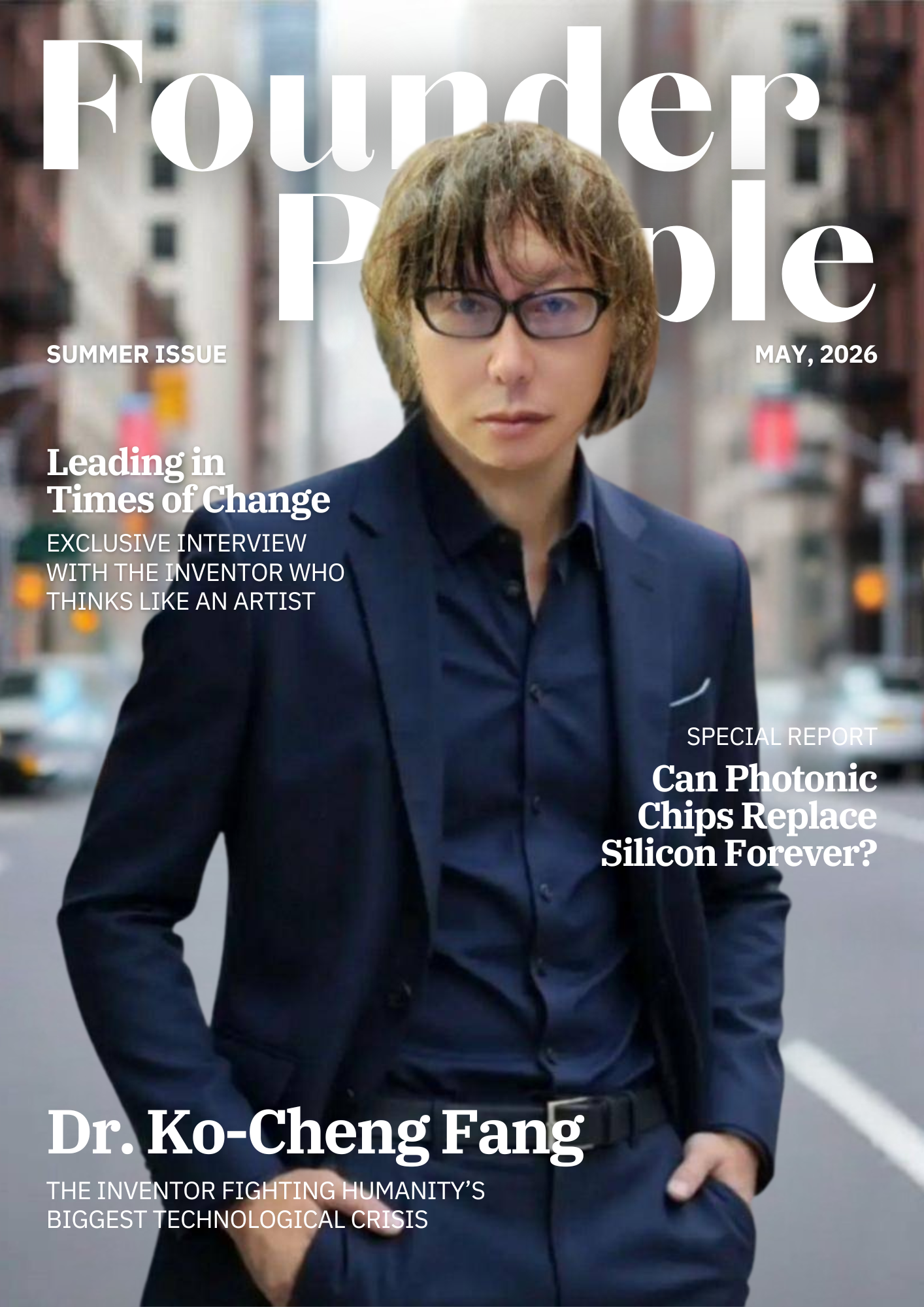
As artificial intelligence rapidly reshapes the modern world, humanity is facing an unexpected problem: the limits of electronic computing.
For decades, the semiconductor industry has achieved astonishing progress by continuously shrinking transistor sizes and increasing chip performance. Smartphones became supercomputers in our pockets, cloud systems transformed global communication, and AI began performing tasks once thought impossible. Yet behind this technological revolution lies an enormous challenge—power consumption, heat generation, and the physical limitations of silicon-based electronic chips.
Today’s AI systems demand unprecedented computational power. Massive data centers consume enormous amounts of electricity, cooling systems require huge infrastructure investments, and semiconductor manufacturers are approaching the nanoscale limits of electronic circuitry. The industry is searching urgently for the next breakthrough capable of sustaining the future of AI.
Now, Dr. Ko-Cheng Fang believes he may have found that answer.

On April 23, 2026, LongServing Technology officially unveiled a revolutionary photonic quantum chip architecture designed personally by Dr. Fang. The announcement introduced the company’s complete photonic pathway system, a 3D structural architecture for the chip, and, for the first time publicly, a structural demonstration of a photonic full-adder chip.
The release represents a major moment for photonic computing—a field many scientists consider the future successor to traditional semiconductor technology.
Unlike conventional chips that process information through electrons moving across metallic circuits, photonic chips use photons, or particles of light, to transfer and compute data. Since light travels significantly faster than electricity while generating far less heat, photonic systems have the potential to achieve extraordinary computational performance with dramatically lower energy consumption.
For years, photonic computing remained largely theoretical or limited by practical engineering barriers. But LongServing Technology’s latest disclosure attempts to move the technology closer to real-world implementation.
At the heart of the announcement is an entirely redesigned computational structure optimized specifically for optical data transmission.
Traditional semiconductor chips rely on highly complex multi-layer electronic architectures. As chips become smaller and more powerful, they require increasingly dense transistor layouts, additional routing systems, and massive fabrication complexity.
Dr. Fang’s design takes a different direction entirely.

Instead of relying on conventional planar electronic structures, the photonic quantum chip has been redesigned into a three-layer architecture using a 45-degree optical pathway system.
The bottom layer functions as photonic memory, enabling direct storage of optical signals. The middle layer contains photonic logic gates where computational processing occurs. The top layer serves as the photonic pathway network responsible for transmitting light-based signals throughout the system.
Each layer is fabricated using separate photomasks, dramatically simplifying structural integration compared to conventional semiconductor manufacturing systems that may require dozens of layers.
According to Dr. Fang, photonic chips do not require the same extreme structural complexity as electronic chips because light itself enables faster and more efficient transmission.
This architecture also demonstrates the stacking capability of photonic systems, opening the possibility for highly integrated future computing platforms.
One of the most important aspects of the unveiling is the integration of photonic memory directly into the computational structure itself.
Current semiconductor systems constantly convert electrical signals into optical signals and back again during processing and communication. These repeated conversions consume energy, generate heat, and create performance bottlenecks.
LongServing Technology’s approach seeks to eliminate much of that inefficiency by enabling direct photonic storage and optical signal transmission inside the chip.
The implications are extraordinary.

According to the company, integrating photonic memory with photonic logic architecture could potentially achieve performance levels hundreds of thousands of times faster than traditional electronic chips.
Because light-speed transmission operates almost instantaneously, Dr. Fang has stated that the true upper performance limit may be difficult to measure precisely.
The unveiling also builds upon another key LongServing innovation: “X-Photon,” a 2-nanometer photonic quantum material developed specifically for nanoscale optical pathways and next-generation photonic chip systems.
One of the greatest barriers in photonic computing has always been wavelength scale.
Traditional silicon photonics systems typically operate between 1300 and 1500 nanometers, which is far too large for modern nanoscale semiconductor integration. Advanced AI processors today require structures approaching single-digit nanometer dimensions.
Dr. Fang’s X-Photon material was engineered to dramatically reduce optical wavelength scale to approximately 2 nanometers, allowing photonic systems to operate at dimensions far closer to current semiconductor manufacturing standards.
This could potentially solve one of the industry’s biggest challenges: how to combine optical computing with ultra-dense chip architecture.

Beyond performance, however, Dr. Fang sees photonic quantum computing as essential for the future sustainability of global technology.
Artificial intelligence is now one of the largest emerging energy consumers in the world. Data centers require enormous electrical infrastructure, while advanced semiconductor fabrication plants consume energy on a scale comparable to entire cities.
As AI systems become more advanced, the environmental burden continues growing.
Photonic computing offers a radically different possibility.
Because photons produce significantly less heat and consume less energy during transmission, photonic chips could dramatically reduce the power requirements of future AI systems while also lowering cooling demands and carbon emissions.
This may ultimately become one of the defining advantages of photonic quantum technology.
The potential applications extend across nearly every major industry.
Photonic quantum chips could eventually power advanced robotics, autonomous transportation systems, aerospace technologies, AI cloud infrastructure, scientific simulation platforms, telecommunications networks, medical imaging systems, and next-generation intelligent machines.

Dr. Fang believes humanity is entering a new technological era where electronic chips alone may no longer be capable of sustaining future AI development.
Yet despite the ambitious scope of the project, LongServing Technology is not approaching the industry through confrontation.
Instead of attempting to replace semiconductor manufacturers directly, the company is actively seeking global foundry partnerships to help existing fabrication facilities transition gradually toward photonic quantum chip production.
This collaborative strategy could potentially accelerate adoption without forcing the industry to rebuild semiconductor infrastructure entirely from scratch.
For Taiwan, one of the world’s most important semiconductor hubs, the implications are especially significant.
Taiwan’s economy and technological leadership have long been deeply connected to semiconductor manufacturing. If photonic quantum systems become commercially viable, Taiwan could once again stand at the forefront of the next global computing revolution.
Still, skepticism remains natural.

The transition from electronic chips to photonic quantum systems represents one of the most difficult technological transformations ever attempted. Yet many of history’s greatest innovations once appeared impossible before becoming reality.
The steam engine transformed industry. The airplane reshaped transportation. The internet revolutionized communication. Artificial intelligence is redefining modern civilization.
Now, photonic quantum computing may represent the next chapter in humanity’s technological evolution.
And through LongServing Technology’s newly unveiled architecture, Dr. Ko-Cheng Fang is positioning himself at the center of that future—one where the speed of light may ultimately replace the limits of electricity.
Contact Information
Dr. Ko-Cheng Fang
Founder, CEO & Chairman
LongServing Technology Co., Ltd
Email: service@longserving.com.tw
Website: LongServing Technology Official Website
Instagram: @ko_cheng_fang_david

Post Comment